
A Tale of Two Managers
The role of trust in sales performance.

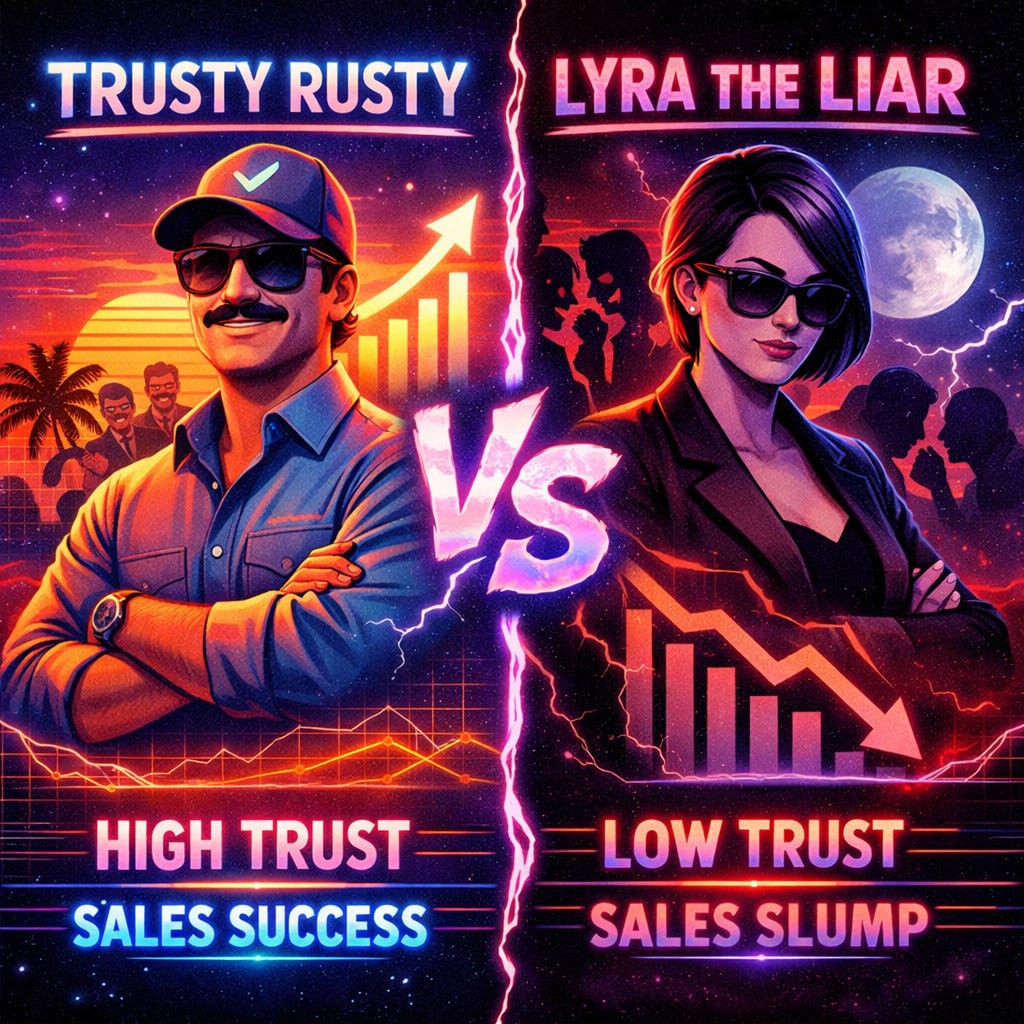
Imagine two managers: Trusty Rusty and Lyra The Liar.
Each sets their team a challenging target. But while Rusty’s team feels motivated to work together on achieving it, Lyra’s team roll their eyes and plough on through another day alone.
The difference? Rusty’s team feels that he has their back. The target is tough, but the effort is shared.
Lyra’s team feels like they’ve been set up to fail. They don’t trust Lyra, and think she’s out for herself.
We’ve written before in this newsletter about the impact of trust on team performance. A 2015 paper from researchers at the University of Sheffield found that trust positively relates to a team’s financial performance, employee productivity and service quality.
In 2013, Crossley, Cooper & Wernsing found that the more trust a manager can instill in their teams, the better results will be.
Now, our own data backs this up.
Late last year, we asked 279 managers questions about their team’s sales performance and retention. Key metrics that indicate how a team is performing.
We then put those managers through our Manager Skills Assessment, and looked for a relationship between their assessment scores and business results.
🕵️ What did we find?
When we rank managers on a five-point scale, every one-point increase in trust corresponds with an average 22% increase in their team’s sales performance.
That’s followed by:
Active listening - 20%
Coaching - 16%
Delegation - 14%
Far from being ‘soft skills’, Trusty Rusty’s ability to build trust leads to a measurable increase in his team’s financial performance.
While Lyra the Liar, whose future was ruined by the harsh realities of nominative determinism, continues to lead a team where trust is as elusive as their sales.
We’ve summarised the results of our research, including the impact of these skills on retention, in a new infographic.
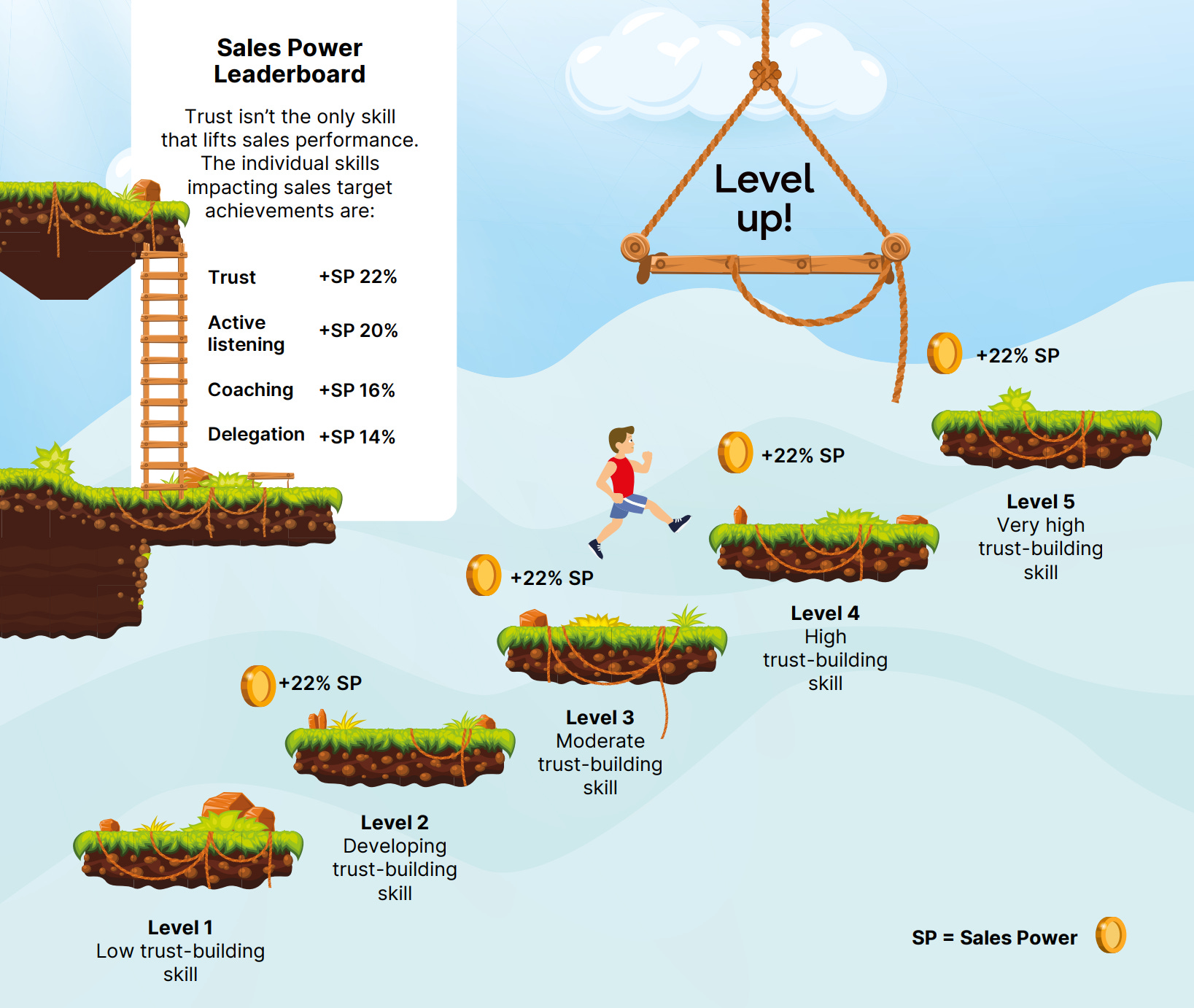
Download the full infographic to discover the impact of these skills on team retention.
So if trust is the lever, how do you actually build it? Our Skills Accelerator and Manager Skills Workshops focus on the 12 key skills that we know make a difference. Email custom@mindtools.com or hit reply to this email and I’ll come back to you!
🎧 On the podcast
Last week, it was ‘Bring Your Paper to Work’ day here at Mindtools Kineo! (We know, we are nerds…)
So in this episode of The Mindtools L&D Podcast:
Ross G discussed lessons from 30 years of meeting science, based on: Rogelberg, S. G., Kreamer, L. M., & Gray, J. (2026). ‘Thirty years of meeting science: Lessons learned and the road ahead.’ Annual Review of Organizational Psychology and Organizational Behavior, 13, 415–442.
Dr Anna B discussed a simple way to increase psychological safety in teams, in: Castro, S., Englmaier, F., & Guadalupe, M. (2024). ‘Fostering psychological safety in teams: Evidence from an RCT’. Academy of Management Proceedings, 2024(1), 16624.
Ross D discussed the impact of AI on how we build skills: Shen, J. H., & Tamkin, A. (2026). ‘How AI impacts skill formation’ (arXiv preprint arXiv:2601.20245).
Check out the episode below. 👇
You can subscribe to the podcast on iTunes, Spotify or the podcast page of our website.
📖 Deep dive
A new paper from researchers at Northwestern University and Stanford explores how different training approaches affect people’s ability to demonstrate empathy.
In a randomised controlled trial, participants were split into three groups and asked to respond to simulated scenarios. One group received no feedback, one watched short training videos, and one received personalised AI feedback on their responses.
Two findings stand out. First, there’s little relationship between how empathetic people think they are and how empathetic their responses actually come across. Feeling empathy isn’t the same as expressing it.
Second, empathy can be trained. Both the video and AI groups improved, but those receiving AI feedback improved more.
The likely reason is that feedback was immediate, specific, and tailored to each response, making it easier to act on.
Empathy isn’t just a trait, but a skill that can be developed at scale.
The result is important to us because empathy is one of the skills in our Manager Skills Framework. We know it leads to better innovation and profit, as well as a reduction in physical ailments in teams. And we’ve just added AI Skills Practice to our empathy workshop for managers.
Kumar, A., Poungpeth, N., Yang, D., Lambert, B., & Groh, M. (2026). Practicing with language models cultivates human empathic communication. arXiv
👹 Missing links
🏆 Further evidence that managers matter
Perhaps because we recently published our own research on manager impact, a summary of longer-term trends in The Economist caught my eye. It’s reassuring how closely the findings align: research by Nicholas Bloom and John Van Reenen links management quality to productivity at scale, while studies from Michela Giorcelli show the benefits can last for years. Reviews by David McKenzie point in the same direction, with consistent gains in performance when managers are developed. It all adds up to a simple idea: when managers get better, organisations do too.
🔁 Real performance requires “double-loop learning”
Ever feel like you’re constantly fire-fighting at work? In this LinkedIn post, John Whitfield argues that it’s because most organizations never actually fix the problems they face. Instead, they make tweaks, creating a Standard Operating Procedure, and run a training event. Then they go back to the old way of doing things. Real solutions require “double-loop learning”, where underlying assumptions are tested and systems are tackled. It’s hard for all sorts of reasons, which is perhaps why the meta-analysis John shares finds that almost no one does it.
🕵️ Our profession’s insider secrets
Loyal readers will know that a few months ago we crowdsourced ‘insider secrets from L&D’. We’ve now written these up in an article for Training Zone, where I argue that L&D doesn’t have a knowledge problem, it has an application problem. We know what works: practice, feedback, and relevance to real work. All of which are reinforced when managers support it and workflows make space for it.
👋 And finally
Horrified this week to discover that someone recorded my last 1:1 with my Dispatch friend-and-co-author Ross Dickie…
👍 Thanks!
Thanks for reading The L&D Dispatch from Mindtools Kineo! If you’d like to speak to us, work with us, or make a suggestion, you can email custom@mindtools.com.
Or just hit reply to this email!
Hey here’s a thing! If you’ve reached all the way to the end of this newsletter, then you must really love it!
Why not share that love by hitting the button below, or just forward it to a friend?