

I recently enjoyed a Reddit thread where folks shared insider secrets from their profession. For example, ‘Schedule your surgery for first thing in the A.M.’, or ‘wash new clothing before you wear it’.
It’s the kind of advice that’s well known to those in the biz, but shocks (or disgusts) outsiders.
Such secrets also provide a window into how professionals see themselves. So we thought it would be fun to turn this same gaze upon the learning and development industry. What L&D secrets should the world know?
Needless to say, we were horrified by what we found.

We gathered responses from LinkedIn, grouped them under themes, and dove into indicative examples. A summary of themes, ranked in order, is shown below.
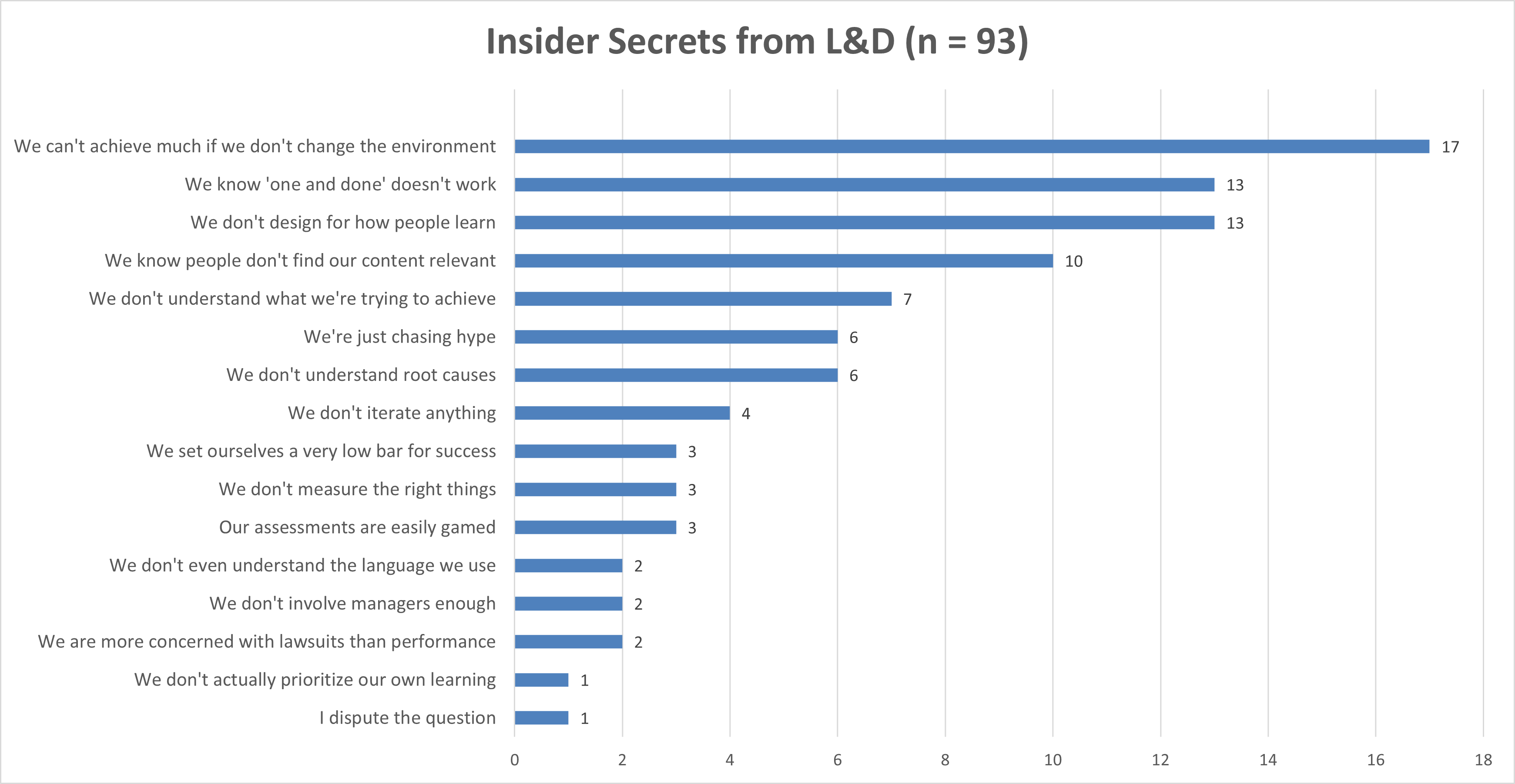
So, with the usual caveats about the self-selecting nature of people who commented, let’s dive in!
🎰 We can’t achieve much if we don’t change the environment
A clear winner. 17 of the 93 respondents noted that the biggest hurdle to a learning intervention being effective is that nothing outside of the intervention changes.
We paint a picture for how we want learners to behave, then return them to a context where systems, processes, leadership and physical environments reinforce the exact opposite.
As Nina Bressler wrote:
‘Most learning initiatives don’t fail because of bad content. They fail because nothing around the learner is allowed to change. Immunity to Change is real at the level of people - teams - organizations - society.’
💊 We know ‘one and done’ doesn’t work
We’d all love it if we could launch a standalone course or workshop and solve our workplace challenges. But real changes demands sustained effort with, as Rob Foster writes:
… ‘practice, feedback, reinforcement. The “event” is just a small slice of the learning journey.’
🧠 We don’t design for how people learn
12 respondents point out that how we design learning runs counter to what we know about how people learn. Michael Shackleton made a good point about giving learners choice in how to access learning. Guy Wallace called out a lack of practice with feedback. And Stella Collins highlighted what I think is the most challenging secret, for both designers and learners:
‘Learners must do the work.’
😴 We know people don’t find our content relevant
What would our customer, the learner, actually want from their L&D department? Probably something relevant, actionable, and that helps them get their job done.
Rance Greene writes:
‘The better you know your learning audience the better design choices you will make. You’ll recognize fluff and get laser-focused on skill-building.’
🧭 We don’t understand what we’re trying to achieve
A rather damning secret. A lot of the time, learning projects “fail” because we have no idea what they were actually meant to achieve. Instead of challenging stakeholders to define a desired business or performance outcome, we jump straight into design to avoid an awkward conversation.
Peter Mitchell writes:
‘Not really a secret but when designing start with the end in mind. What is the behaviour or skill you are trying to change/build, rather than “here’s what you need to know...” the end solution may be very different and save time and effort too.’
🤖 We’re just chasing hype
I don’t think L&D are the only part of the business guilty of this one. Did we mention AI yet in this newsletter?
Aerielle St. John writes:
‘The latest shiny thing might be cool but it’s not worth spit if you don’t employ good foundational [instructional design] principles when using it.’
📉 We don’t understand root causes
If we don’t know what we’re trying to achieve a lot of the time, then it follows that we also don’t know what’s causing the problem we never identified.
Simon House writes:
‘It’s not actually a [Training Needs Analysis] if no analysis has taken place on the data you collected.’
🔁 We don’t iterate anything
There’s too many new projects to work on to look back at the improving the old ones.
Says Kamran Wadood:
‘Whatever happens to the feedback forms?’
🍾 We set ourselves a very low bar for success
What would success look like to you?
Tony Manwani writes:
‘That if a facilitator can get one person in the room to change one thing for the better, we’d probably call that a win.’
⏱️ We don’t measure the right things
No arguments here. My colleagues on our Insights team say this every day.
Stéphanie Heyraud writes:
‘Unless relevant metrics are set up from the get-go to measure ROI and/or a change in behaviour, how can one claim the training yield the expected results?’
🎮 Our assessments are easily gamed
It’s hard to create an effective assessment. Most can be passed without ever learning anything. As Jonathan Hill points out:
‘The longest answer is usually the correct one.’
💬 We don’t even understand the language we use
This one brought back memories of my first few weeks in an L&D role. Chris Palmer writes:
‘It doesn’t really matter what you call them. Skills, capabilities or competencies are really just the same thing and employees don’t really care what we call them as long as they have an easy way to develop themselves.’
I completely agree, and after 13 years in this industry I’m still not clear on the difference.
👩🏽💼 We don’t involve managers enough
Preach! Managers are one of the biggest factors in whether a learning intervention leads to change, or is immediately undermined.
David Swaddle writes:
‘L&D needs to work with everybody else in the org to make sure that programs involve managers in pre- and post-training processes for success.’
⚖️ We are more concerned with lawsuits than performance
I’m shocked, SHOCKED, I say.
Our friend Connie Malamed writes:
Some organizations use training to protect themselves from liability lawsuits rather than to improve performance.
🎓 We don’t actually prioritize our own learning
… I thought this would be a lovely note to end on, from LaQuin Taylor:
‘You can’t pour from an empty cup! Own & prioritize your continuous development as a learning professional!’
… until I saw…
🫤 I dispute the question
‘Don’t share your “insider secrets” on random posts looking to take said secret and use it without giving credit/citing source…’
That’s the take from Rosler, S. (2026). ‘What’s an insider secret from L&D that everyone should probably know?’. LinkedIn. Retrieved: 15 January 2026. 😉
Want to create learning that really has a lasting impact? Here’s a quick summary based on the above:
Understand the environment you’re working in. What factors are shaping current behavior?
Why do those factors exist? Root-cause analysis tools can help.
Collaborate with stakeholders to define the change you want to see.
Develop a measurement strategy so you can report to the business on how the intervention performed (and iterate it!)
Factor environmental factors and learner concerns into your design.
Embed sustainable change with follow-up assets, practice opportunities and the support of managers.
That list is, of course, how our Custom and Insights teams tackle workplace learning challenges. Want to find out how we can help you? Get in touch by emailing custom@mindtools.com or reply to this newsletter from your inbox.
🎧 On the podcast
Learning design work is often accompanied by various forms of uncertainty: ambiguous performance needs, vaguely defined scope, shifting stakeholder expectations.
In his book The Instructional Designer’s Guide to Project Management, Dr Guieswende Rouamba describes this condition as ‘the fog of instructional design’. And he believes project management is the key to navigating it.
In this week’s episode of The Mindtools L&D Podcast, Dr Rouamba joins Ross D and Adria Maston, Head of PMO at Mindtools Kineo, to discuss:
why he wrote the book, and why project management is a critical skill for learning designers;
what learning designers most often underestimate about the human side of project management;
what he means when he says ‘the best way to resolve conflict is to prevent it’.
Check out the episode below. 👇
You can subscribe to the podcast on iTunes, Spotify or the podcast page of our website.
📖 Deep dive
‘All practitioners in all fields probably deploy practices of limited or no value. HR practitioners are no different.’
This quote from Rob Briner on LinkedIn caught my eye, in a comment on the paper ‘The Illusion of Performance Management’ from the University of Limerick.
In the paper, Professor Kevin Murphy argues that performance management robs workers of agency while simulatenously failing to deliver value for organizations.
I’m certain that, in the majority of cases, that’s true.
First, the paper argues that the main goal of performance management is to align the behaviors of each worker with the strategic goals set by that organization’s leadership team.
Second, that the tools employed to ensure this alignment include individual and team goals, performance plans and feedback.
In other words: the assumptions behind performance management are that the leadership team have made the correct decisions, that those decisions are fixed for a certain period of time, that any failure to deliver results is due to non-conformance by the workers, and that the role of managers and supervisors is to ensure conformance through a mix of rewards and punishments.
Murphy argues that those assumptions are dubious at best and, in many cases, likely to lead to failure. Instead, he makes a case that this approach is locked in the past and points to evidence that leadership delivers better results when it focuses on listening and providing support to workers.
Murphy, K. R. (2025). The Illusion of Performance Management. Human Resource Management.
👹 Missing links
Long-term readers will know that we’ve long been fans of learning evaluation researcher Will Thalheimer. Will’s inspired our own approach to measurement, and has just launched his 2026 GROWLE study (Global Research on
Workplace Learning Evaluation). He’s seeking participants to take part, and is keen to hear from you! The survey takes about 20 minutes, responses are confidential, and the final output will surface the evaluation practices, priorities and challenges of L&D professionals. All wrapped up in a free report!
🏀 Apple Vision Pro: New format, old techniques
It’s common when new media formats emerge to copy what came before. Early films mimicked the style of vaudeville theatre. The Kindle mirrors the format of physical books. Then, over time, creators start to play with the unique properties of their tools. According to Stratechery writer Ben Thompson, the Apple Vision Pro isn’t quite there. Promised immersive courtside seats at NBA games via the magic of virtual reality (VR), Thompson argues that legacy TV production techniques like cutting between multiple cameras rip the viewer out of the experience. It’s an interesting read for learning designers adapting their craft to new contexts.
🤖 The rise of AI-native employees
While leaders hesitate to roll out new AI technologies and create governance frameworks, employees are getting on with the job. That’s the view of my colleague Rodrigo Bolaños, Executive Director of Global AI Strategy at Mindtools Kineo. In an article for The AI Journal, Rodri argues that the productivity benefits of AI are so clear to frontline employees that they jump on free tools without any thought to where their data is going. Leaders can either support this adoption with frameworks, technology and training, or it will happen without them.
🤓 A brief note…
Speaking of AI, Mindtools Kineo just launched an AI Innovation Lab, headed up by Rodrigo!
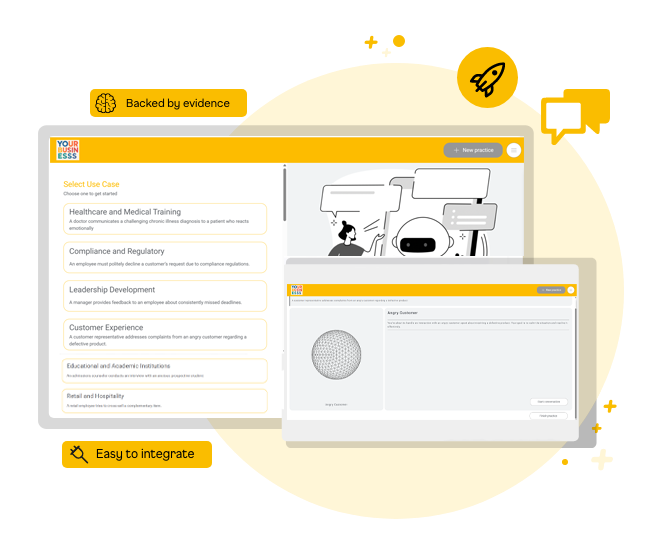
The team’s AI Skills Practice tool is available now, using immersive simulations with text and voice to help users practice skill development in realistic scenarios. Users receive both quantitative and qualitative feedback on their performance, and the scenarios can be used as standalone experiences or as part of blended learning pathways.
👋 And finally…
This clip nicely captures the pace of AI product development. It really is exhausting at times.
👍 Thanks!
Thanks for reading The L&D Dispatch from Mindtools Kineo! If you’d like to speak to us, work with us, or make a suggestion, you can email custom@mindtools.com.
Or just hit reply to this email!
Hey here’s a thing! If you’ve reached all the way to the end of this newsletter, then you must really love it!
Why not share that love by hitting the button below, or just forward it to a friend?
A fun read!! Thanks.